
Product Overview
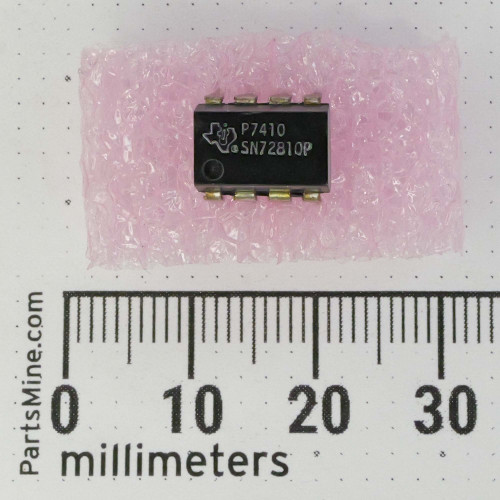
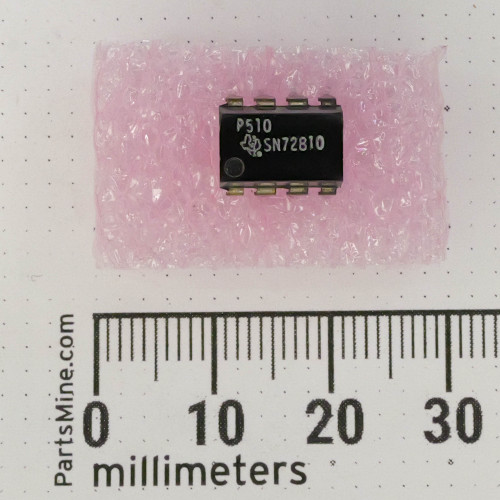
Vintage Texas Instruments SN72810 High-Speed Differential Comparator IC
This comparator serves legacy analog and interface circuits that rely on early high-gain linear devices. It supports rapid threshold detection for amplitude discrimination or memory sense tasks, and its bipolar-supply topology aligns with 1970s comparator conventions. A logic/analog synonym helps match varied schematic terminology.
Product Condition
Unused, New Old Stock.
Product Overview
The Texas Instruments SN72810 is a high-speed differential comparator introduced in the early 1970s, designed as an enhanced successor to the SN72710. It incorporates increased gain and improved offset performance for precise threshold detection in mixed-signal and early digital-interface equipment. The device operates from bipolar supplies and provides TTL/DTL-compatible outputs. Package drawings and pin assignments in the TI datasheet show a 14-pin configuration with the case-connected ground at pin 4.
Key Features
- High differential voltage gain, typically 33,000
- Fast response time of 30–80 ns
- TTL/DTL-compatible output characteristics
- Operates from bipolar ±5 to ±7 V supplies
- Input offset voltage typically around 1.6 mV at 25°C
- Common-mode input range extending to approximately ±5 V
- 14-pin plastic DIP with case-tied ground pin
Applications
- Amplitude discrimination in analog instrumentation
- Memory sense amplification in early digital systems
- High-speed limit and threshold detection
- Restoration of vintage comparator modules
- Reference builds replicating 1970s comparator behavior
- Bench studies of classic high-gain linear architectures
Frequently Asked Questions
Does the SN72810 operate from dual supplies?
Yes. Typical operating points use +12 V and −6 V rails, consistent with the datasheet’s electrical tables and test conditions.
How does this device differ from modern comparators?
It uses a high-gain bipolar linear design optimized for TTL/DTL interfacing and bipolar supply rails, unlike today’s low-power or rail-to-rail comparators.
Is its pinout compatible with contemporary devices?
No. The SN72810 uses a 14-pin layout with several NC pins and a case-connected ground, which differs from modern 8-pin comparators.
Why is the response time specified with overdrive?
The comparator’s speed depends on input overdrive; a 100 mV step with 5 mV overdrive yields the documented 30–80 ns range.
Use this comparator to restore high-speed threshold circuits by applying its TTL/DTL-compatible output and high differential gain while installing it into the original 14-pin location on your existing logic board.