

Product Overview
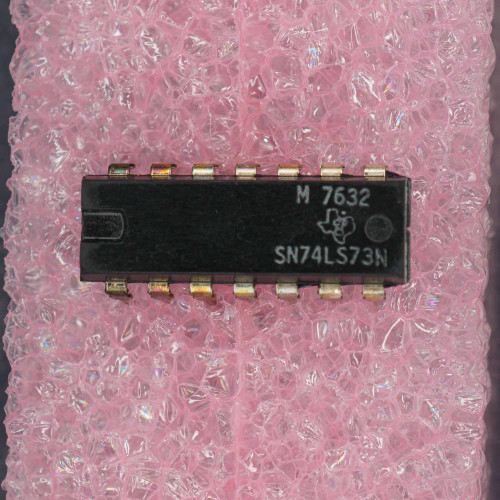
SN74LS73N Dual JK Flip-Flop with Clear — Negative-Edge Triggered, 14-Pin DIP, Low-Power Schottky TTL
Condition
Unused NOS sourced from an electronics parts distributor that was winding down operations. Pins show slight age-related tarnishing — cleans off with a citric acid solution. Evaluation: Visual inspection only. Function testing not performed.
Ships same business day from Idaho. Packed carefully.
Product Overview
Texas Instruments SN74LS73N. Dual JK flip-flop with independent clear inputs on each flip-flop. Low-Power Schottky TTL logic. 14-pin plastic DIP — through-hole, breadboard and PCB compatible. Negative-edge triggered: state changes on the falling edge of the clock signal only.
Key Features
- Function: Dual JK flip-flop with Clear
- Trigger type: Negative-edge (falling clock edge)
- Package: DIP-14 (14-pin plastic dual in-line)
- Technology: LS — Low-Power Schottky TTL
- Supply voltage: 4.75V to 5.25V DC
- Max clock frequency: 30 MHz (typical)
- Operating temperature: 0°C to 70°C (commercial grade)
Applications
- Repair and restoration of vintage 8-bit computers (Apple II, Commodore series)
- Classic arcade PCB logic repair (Pac-Man, Galaga, and similar boards)
- Clock division and frequency counter circuits
- Legacy industrial control logic replacement
- Hobbyist breadboard and through-hole prototyping
Frequently Asked Questions
Is this positive-edge or negative-edge triggered?
Negative-edge triggered. The flip-flop responds only when the clock signal falls from High to Low. If your circuit requires a positive-edge triggered device, you need a different IC such as the 74LS74.
Is this compatible with 3.3V CMOS systems?
No. The SN74LS73N requires a regulated 5V supply (4.75V–5.25V) and TTL logic levels. It is not compatible with 3.3V CMOS systems without level shifting.
Is the SN74LS73AN a direct substitute?
In most applications, yes. The SN74LS73AN is an updated variant with slightly improved switching characteristics and is generally interchangeable. Verify pinout against your board before substituting.
Do I need to clean the pins before use?
The pins show minor age tarnish typical of NOS inventory. A citric acid solution removes it. Clean pins improve solder joint reliability and contact in sockets.
Verify the pinout against your board's datasheet before installation — some 7473 variants from different manufacturers differ in VCC and GND pin placement.