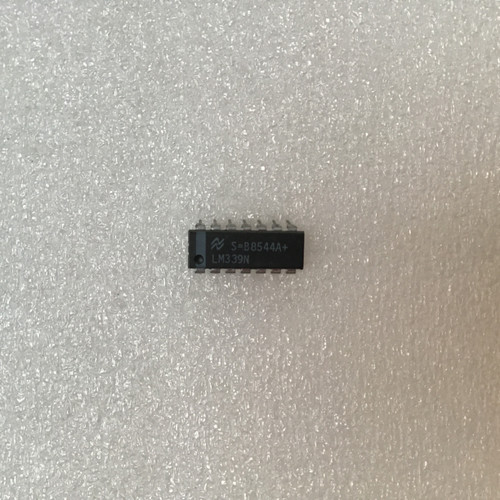


Product Overview
DM74ALS32N ALS TTL Quad 2-Input OR Gate - 5V, 14-Pin PDIP, Through-Hole Glue Logic
Condition
Unused NOS. Chips are in excellent condition with no visible damage. Evaluation: Visual inspection only. Function testing not performed. Sourced through a network of surplus and legacy suppliers. Covered by our satisfaction guarantee.
Ships same business day from Idaho. Packed carefully.
Product Overview
National Semiconductor DM74ALS32N - quad 2-input OR gate in a 14-pin plastic DIP package. ALS (Advanced Low-Power Schottky) TTL technology. Four independent gates on one chip. Each gate drives its output high when either or both inputs are high. Standard 5V logic, through-hole mounting.
Key Features
- Logic function: Quad 2-input OR gate - four independent gates per package
- Technology: ALS TTL (Advanced Low-Power Schottky) - faster than LS, lower power than S
- Package: 14-pin PDIP, through-hole - breadboard and socket compatible
- Operating voltage: 5V (4.5V to 5.5V)
- Propagation delay: 5ns to 9ns typical
- Operating temperature: 0°C to 70°C (commercial grade)
Applications
- Glue logic on vintage 8-bit and 16-bit computer boards - memory addressing, I/O selection
- Logic control boards in legacy industrial automation equipment
- Signal combining and pulse routing in timing circuits
Frequently Asked Questions
Is this compatible with 3.3V logic systems?
No. The DM74ALS32N requires a 5V supply (4.5V to 5.5V). It is not directly compatible with 3.3V logic without level shifters.
How does ALS compare to standard 74LS32?
ALS is faster (5-9ns vs. approximately 15ns for LS) and consumes less power than S-series. It is a drop-in functional equivalent in most 5V TTL designs, but verify timing margins if replacing LS in a timing-critical circuit.
Is this the original National Semiconductor part?
Yes. These are NOS chips sourced through surplus and legacy supplier channels - not modern reproductions or TI equivalents.
Is a datasheet available?
The DM74ALS32 datasheet was published by National Semiconductor and is available through Octopart, Fairchild archives, and similar component aggregators.

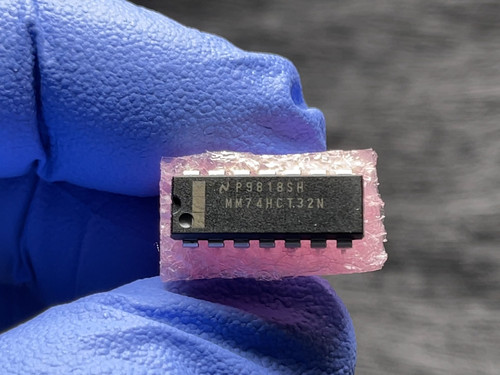
![Quad 2-Input NOR Gate - National Semiconductor MM74HC02N [[product_type]] PartsMine](https://cdn11.bigcommerce.com/s-cl52ybm741/images/stencil/500x659/products/3715/8268/Quad-2-Input-NOR-Gate-National-Semiconductor-MM74HC02N-producttype_8251__73625.1736984945.jpg?c=2 "Quad 2-Input NOR Gate - National Semiconductor MM74HC02N [[product_type]] PartsMine")