

Product Overview
1.5nF General Purpose Radial Ceramic Capacitor for Signal & Timing
Product Condition
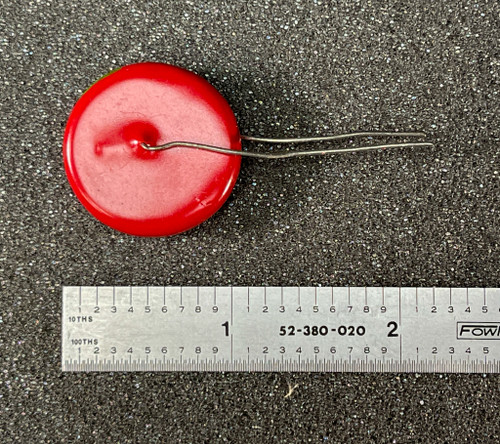
Unused, New Old Stock. Unbranded ceramic capacitor marked “152” only. Yellow epoxy-dipped body with radial leads. No voltage, tolerance, or manufacturer markings present.
Ships same business day. Reliable parts since 1999. Honest pricing, no nonsense.
Product Overview
General purpose ceramic capacitor with a nominal capacitance of 1500 picofarads. The “152” code decodes as 15 × 10² pF, which equals 1500pF (1.5nF or 0.0015µF). This is a non-polarized component and can be installed in either orientation. Radial leads support standard through-hole PCB mounting.
With only the capacitance marking present, this part should be treated as a general-purpose ceramic capacitor suitable for low-voltage, non-critical circuits. Ideal for signal coupling, small timing networks, and noise filtering where exact dielectric type and tight tolerance are not required.
Key Features
- Capacitance: 1500pF (1.5nF / 0.0015µF)
- Marking: “152” (standard 3-digit capacitor code)
- Non-polarized ceramic construction
- Radial lead configuration
- Through-hole PCB mounting
- Epoxy-dipped body style
- Compact size for dense layouts
- Suitable for general-purpose electronic use
Applications
- RC timing circuits with short time constants
- Signal coupling in low-level analog circuits
- High-frequency noise suppression
- Bypass capacitor in combination with bulk capacitance
- Logic-level filtering in hobby electronics
- Educational labs and breadboard builds
- General electronics repair projects
Frequently Asked Questions
What does the “152” marking mean?
It follows the standard 3-digit capacitor code. The first two digits are significant figures (15) and the third digit is the multiplier (10²), resulting in 1500 picofarads.
Is this capacitor polarized?
No. Ceramic capacitors of this type are non-polarized and can be installed in either direction.
What is the voltage rating?
No voltage rating is printed on the body. It should be treated as a general-purpose part and used only in low-voltage applications unless independently verified.
What dielectric type is it?
The dielectric class is not marked and cannot be confirmed from the available labeling.
Is tolerance specified?
No tolerance code is present. If capacitance precision matters, measurement before installation is recommended.
Simple marking, wide utility. A small ceramic cap that earns its place in the quiet corners of a circuit.